
Sheriff Hutton Castle in the North Riding of Yorkshire
Updated: Feb 14

Set on a low ridge with extensive views over the Vale of York and beyond, the imposing ruins of the Neville stronghold at Sheriff Hutton lie at the centre of a fascinating medieval landscape, considerable traces of which can still be seen today.
Sheriff Hutton castle - part of an older landscape
Sheriff Hutton Castle in the North Riding of Yorkshire presents the visitor with surely one of the most dramatic sets of ruins in the whole of the British Isles. Visible for miles across the largely flat Vale of York, the ruins which can be seen today barely hint at the power and majesty the castle once represented in the land.
Sheriff Hutton itself boasts two castles. One, the remnants of an earthwork motte and bailey castle, is situated to the east of the village next to the church of St Helen and the Holy Cross.
The other, at the western end of the village, is an enormous quadrangular castle, not dissimilar to those at Middleham and Bolton-in-Wensleydale.
Both of Sheriff Hutton's castles, as well as its church and the village itself, also form part of a much bigger landscape; ancient ridge and furrow field systems hint at the life of the peasantry while, to the south, a huge deer park tells of an altogether different way of life.
The earlier motte and bailey castle at Sheriff Hutton
The proximity of the current church and the motte and bailey castle point to a long-standing and intimate relationship between church and aristocracy, the spiritual and temporal worlds.

Although architecturally much of the church dates to the fourteenth and fifteenth centuries, the nave and lower parts of the tower are earlier, dating to the twelfth century when the castle seems to have been founded.
The motte and bailey is accessible via a gateway in the wall next to the church. The bailey banks are quite substantial, suggestive of a strong local power base at the moment of its establishment.
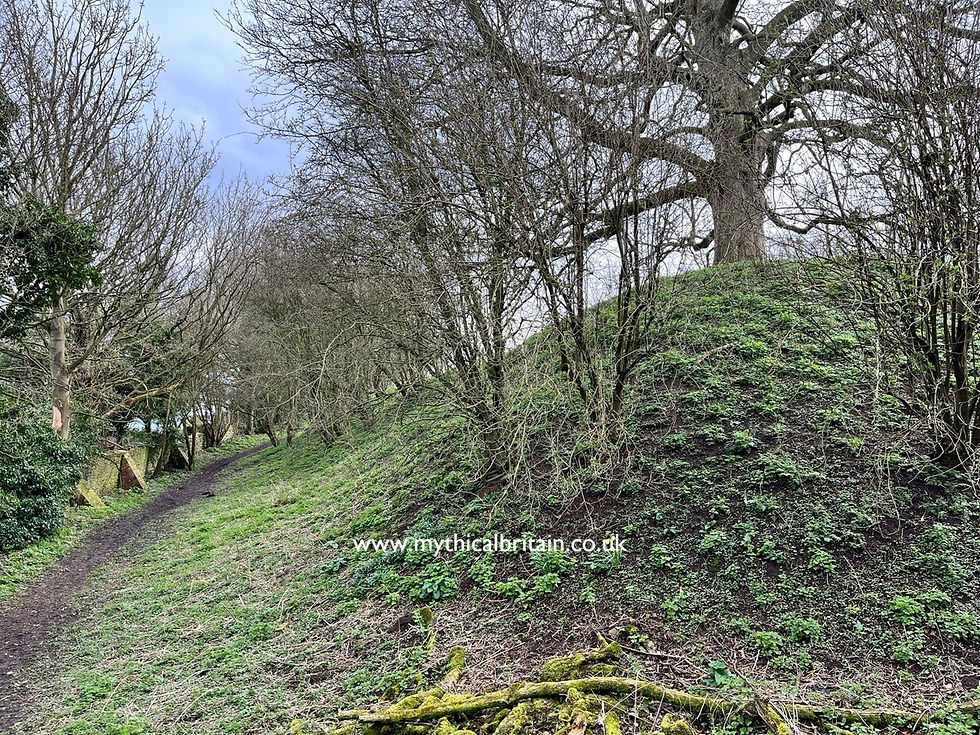
As many authors have highlighted in recent years, timber castles remained in use well into the fourteenth century. Iolo Goch’s poem about the hall at Sycharth castle in Wales, former residence to Owain Glyndwr, is not only testament to this but also to the impressive nature of such buildings’ internal decoration and appearance.
At Sheriff Hutton, the size of the earthen banks suggests a residence of similar importance here. The effigy in the church to Sir Edmund de Thwing (or Thweng) of nearby Cornborough (d. 15th October 1344) potentially reveals a continued connection between church, local lords and the earthwork castle well into the fourteenth century.

Notwithstanding, the date of the castle’s founding is unclear. David Cathcart-King, in his monumental Castellarium Anglicanum, considers it to have been a construction of the Anarchy of 1138-1153. The Victoria County History (VCH) states the castle was established by Bertram de Bulmer in 1140.
Others have suggested it may have been established prior to 1100 as the centre of an estate belonging to Aschetil de Bulmer. De Bulmer was Sheriff of Yorkshire from 1115, which accounts for the appearance of "Sheriff" in the name of the village.
Old aerial photographs taken after the Second World War, and even Google Earth views today, show extensive ridge and furrow fieldworks around this end of the village.
Significantly, these images appear to show that the castle cuts through a pre-existing farming landscape, rather than the village and fields subsequently being built around the castle. If it was an imposition on an earlier village site, this may support King’s argument.
Oliver Creighton, in his book Castles and Landscapes, has suggested that the imposition of the castle represents “the re-orientation of an earlier plan.” Traces of a village bank to the north also hint at a subsequent assertion by way of a planned settlement.
Sheriff Hutton and the Neville family

Certainly, what we see at Sheriff Hutton today is an example of a village which expanded away from the original settlement and beyond its then planned boundaries. The current stone castle tells us why.
In 1382, dramatic events occurred in the village when Sir John Neville of Raby was granted licence to crenelate at Sheriff Hutton, building a huge palatial castle which not only dominated the village but also the local landscape for miles around.
The new castle was designed to “become the heade and capitall of his residence”, according to a reference in the Victoria County History. In other words, this was to be a building of status.

The Nevilles were amongst some of the most powerful figures in the medieval north and had been Sheriffs of York since the thirteenth century. The palace built at Sheriff Hutton bears testimony to their power and influence. Although it is now much destroyed, a comparison with Middleham or Bolton-in-Wensleydale gives an idea of how it once must have looked.
But unlike these castles, which seemed to have been placed within their landscapes, Sheriff Hutton was built to dominate its own, to sit above it. What remains of its towers even today stand to nearly 100’ in height, and this is before we consider the impact of its location on its low ridge.
To the south, the power of the Nevilles was further exemplified by a vast deer park, the plan of which can still be traced in the fields and hedges of today.
It is not hard to imagine this sense of power, luxurious living and hunting being at the centre of life, celebrated within the building by hearing poetry and stories such as Sir Gawain and the Green Knight, which themselves captured such lifestyles.
The original appearance of the Neville castle at Sheriff Hutton

As A H Smith explains in The Place Names of the North Riding of Yorkshire, the Old English name Hutton (the farmstead ["ton"] on the ridge/spur ["hoh"]) tells us that the village has always been associated with its elevated position in the landscape. Neville' s great palace exploited this to the full.
A hint of the castle's original appearance in the landscape is gained by the copperplate print etched and engraved by Yorkshiremen Nathaniel and Samuel Buck in the early eighteenth century.
Like many of their prints, that of Sheriff Hutton is designed to contrast the old (usually in the foreground) with the new (in this case, the growth of York).
The benefit of this approach for the modern viewer of Sheriff Hutton is that we can see details of the castle and its setting captured almost accidentally.
Not only do we see curtain walls standing to their full (or at least near complete) height, but we are also aware of the many windows and doors which suggest, as at Wressle, a castle deliberately intended as a palace.
The print’s depiction of York in the distance not only places the castle in its local landscape but also emphasises its former dominance. Here was a castle built as a palatial residence, with views over all the local seats of power; York is small in its shadow.
Although the plain we see in the print is not the deer park, we nonetheless can imagine the park’s flat expanse, further exaggerating the lofty eminence of the Neville palace above it.
For the Buck brothers, we are meant to see the past being overshadowed by the future; four ourselves we see a glimpse of the past which would otherwise have been lost to a future the Bucks could never know.
A progression towards power - a castle built to impress
In building Sheriff Hutton, the Nevilles employed John Lewyn as their architect, a man responsible also for works at Bolton, Carlisle, Dunstanburgh, Warkworth, and possibly Wressle.

The sheer scale of Lewyn’s resultant palace is astonishing. Originally constructed in three wards arranged sequentially, the castle as a whole stretched from the village green (then the market place) to where the current ruins stand.
The design was such that a visitor was lead through levels of ever-increasing architectural grandeur towards the power and majesty of the inner ward with its great towers and ranges. This was a building to impress at every level.
The Historic England listing describes each of these three wards, or “courts” as follows:
The inner court included the hall, kitchen and the lord's stately lodgings including a chapel. The middle court was described [by a survey and by Leland] as being protected by three great towers, the middle tower forming a gatehouse, but in 1525 this court required extensive repairs to its walls, a section of which over 20m [60’] long had collapsed. The outer court included a brewhouse, horse mills, stables and barns.
John Leland’s words specifically state,
I marked [noticed] in the fore front of the first area of the castle itself three great and high towers, of which the gatehouse was in the middle. In the second area there are 5 or 6 towers.
In interpreting this description, if the “three great towers” were not those of the current western wall of the inner court, they were in all likelihood arranged in parallel in front of them to create a distinctive ward of their own.
These towers and their wall were connected to the inner ward by walls to the north and south, sections of which still remain, albeit hugely diminished. This is the ward described by Leland as "the first area of the castle".
Leland's description may also imply that in seeing the “5 or 6 towers” behind the three, that they were taller and grander than those immediately confronting him. What is also clear is that the outer ward is not strongly fortified, if at all.
In other words, the castle proper (what Leland calls "the castle itself") combined the middle and inner courts, with the inner court being the prime residence.
A similar layout can be seen at Conwy in North Wales, in which the inner ward is approached only through the outer and the grandeur of the inner ward is further emphasised by bartizans on its four main towers.

On entering the middle court, visitors would have been aware of the structural massivity of the main palace and the familial power which confronted them. Here, at the entrance to the inner court, was a dramatic gateway above which was a row of four painted carved shields, each announcing that this was the house of Neville.
It is notable that while three of these shields bear the arms of Neville only (a red saltire on a silver field), one is different. In the words of the VCH, the panel contains:
"four carved shields, two surrounded by garters and the others by twisted wreaths. The first, second and fourth bear the arms of Nevill and the third Nevill impaling Beaufort [i.e. the heraldic devices divide vertically down the shield to reflect the marriage of Ralph Nevill to Joan Beaufort, daughter of John of Gaunt, in 1396]. As Ralph Nevill, first Earl of Westmorland, did not receive the garter till 1402, the gateway must have been added after that date."
Perhaps this wall and its gateway represent a final phase in the building, cutting off the middle court from the inner court in one last architectural gesture.
Sheriff Hutton, Richard III and the castle's eventual decline
Sheriff Hutton’s demise mirrors the end of the Neville family, in particular Richard Neville – Warwick the Kingmaker. Upon his death at the battle of Barnet in 1471, and with no male heirs, his estates were forfeited to the crown (Edward IV) and split between the king's brothers.
In the case of Sheriff Hutton, the castle and its estates were were granted to Richard, Duke of Gloucester (the future Richard III) who became Lord of the North.

Richard III's connections are still celebrated today, with a banner in the church featuring his motif of the white boar above the fifteenth century effigy of a young man. This figure at one time was thought to represent Richard's son, Edward, who died in 1484; it is now thought to be Ralph Neville, who died nearly fifty years earlier in 1436.
In later years granted to Henry Fitzroy, an illegitimate son of Henry VIII, Sheriff Hutton castle still periodically hosted the Council of the North and remained a palace of some status until the Council moved to York in 1537. Leland described the castle as being incomparable in the north for its ‘princely lodgings’.
It was during this period that the castle gained an impressive, planned garden, the lumps and bumps of which still survive in the ground to the south of the castle. Of note was a roadway with canals on either side, from which the visitor could admire the splendour of the castle on approaching from below.

However, although Sir George Lawson, steward to the third Duke of Norfolk, was ordered to put repairs in hand in 1536, Sheriff Hutton castle continued to decline. In 1548 the castle’s chapel was dissolved and the castle itself became a prison.
In 1625, the King’s Commissioners noted,
"The bowels of this worthy pile and defensive house are rent and torn ... the case of a stately castle, the inward materials transposed and the walls ruyned".
This description, whereby only the outer walls (the "case") remained, seems to reflect the view captured by the Buck brothers when they came to etch the ruins in the early 1700s.
By this time, with much of its stonework stripped by the castle’s then owners, the Ingram family, Sheriff Hutton’s days were done and much of its stonework used as building materials.

A hundred years later, when the Georgians and Victorians were attracted to the site by its dramatic and romantic ruins, demolition had continued to occur at pace; it is recorded that one of the castle’s remaining (curtain?) walls was even pulled down by a team of horses.
Sheriff Hutton castle today
Despite the romantic interest of the ruins in the nineteenth century, little attention was paid to them in the decades following. Attempts were made in the twentieth century to understand the ownership of the ruins and to implement repairs but these came to little.

When I first visited the site as a young undergraduate in the early 1980s, travelling out from York on my Velocette motor cycle, the site was very much part of a working farm. The ruins were treated seemingly in the way of all such farm buildings – maintaining some form of functional utility until they fall down through neglect.
Undeterred, I sneaked into the farmyard and then into the castle itself. I was both surprised and thrilled to discover, hidden above the tractors, ladders, poles and associated rusty farm machinery stacked up against their ivy-clad wall, the frieze of the four Neville shields still asserting their status despite centuries of decay. In all my years of castle hunting, I cannot think of a more precious moment of delight.
Alas, the entrance passageway itself, the gateway into the former palace, was blocked. Venturing by other means into the inner court, I examined its crumbling features, all the time mindful of an irate farmer suddenly appearing with his shotgun!
Although little remained within the courtyard itself, the northern range contained the extensive remains of cellars and basements. Back then, these were rubble-strewn, overgrown with nettles, and dangerous – but as a young man, such things rarely deter and I was able to venture down into the vaults to engage with them more closely.
In truth, I shouldn't have been there. The whole edifice was in serious danger of complete collapse and there is no doubt my exploration of such fragile ruins was a foolish act. In recent times I have discovered that a report written just a decade after my visit suggested that 90% of the ruins were in need of repointing!
In 2011, however, a significant grant of £900,000 by English Heritage was made for the consolidation of the ruins. Today, although they appear as dramatic as they did to our Victorian ancestors, the ruins of Sheriff Hutton castle are much less vulnerable to time and weather. They are also available to hire as a wedding venue, if you feel so inclined - how times change!
Though now gone the way of all flesh, the power of the Nevilles, once so dominant in the landscape, continues to cast its formidable shadow over the Vale of York today. Sheriff Hutton castle, still standing proudly in its original medieval landscape setting, is a truly special place.
About the author, Michael Smith

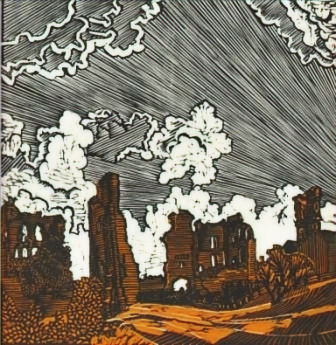
I am a British translator and illustrator of medieval literature. I am also an established printmaker, with work in private collections worldwide.
My books, including translations of Sir Gawain and the Green Knight, the Alliterative Morte Arthure, and William of Palerne, are published by Wilton Square Books and are available through all the usual outlets. All my books feature my own linocut prints as their illustrations.
To find out more about me, please click here
To buy an original print of Sheriff Hutton castle by me (two copies only remaining), please click here
Buy my books!
For more details of my translations of medieval romances and how to purchase signed copies, please click here.
Further information about Sheriff Hutton castle
For the Historic England entry for Sheriff Hutton castle click here
For the Historic England entry for Sheriff Hutton church click here
For the relevant entry in the Victoria County History for Yorkshire, click here
For the link to the website for the castle, including a fly-by drone video of the ruins and their village setting, click here
To buy an original linocut print of the ruins of Sheriff Hutton castle by Michael Smith, click here
Gallery featuring images of Sheriff Hutton castle, motte and bailey and church
Church of St Helen and the Holy Cross at Sheriff Hutton


Comments