
Common People in William of Palerne?

One of the features of the fourteenth century romance William of Palerne (The Romance of William and the Werewolf) is its portrayal of ordinary people. Although different to the bickering vibrancy of Chaucer’s pilgrims, these characters nonetheless show a side to medieval life we don’t often get to see.
A society at work
A key theme of the fourteenth century Middle English romance William of Palerne (The Romance of William and the Werewolf) is its focus on the need for leaders to understand and care about those less fortunate than themselves.
But despite the fact that patron of the romance was one of the richest and most powerful men in England in 1350, this wasn't a medieval equivalent of Blur's famous character in their 1995 song Common People.
In the romance, as the boy William journeys from cruel exile to become emperor of Rome, he encounters many along the way who will eventually become his subjects.
These include a forest cowherd and his wife, young boys, palace guards, quarrymen, charcoal burners and sailors. They all play a role in the story, leaving the reader with a much richer picture of the medieval world than we might gain with a typical Arthurian romance of the time.
We come to see them as the warp and weft of society. We understand how society works.
The Cowherd
We meet the Cowherd after William has been whisked away from the murderous hands of his nurses by the Werewolf. Left alone in a burrow while the Werewolf searches for food to sustain him, the boy ventures outside.
Frightened by the appearance of the cowherd and his dog, William hides away again until the cowherd tempts him out with an apple. We are introduced to a simple life in the forest in which William is the perfect son for the childless cowherd and his wife [ll. 25-108].
What is clear is the simple love his new family have towards him. When the Roman emperor discovers William and asks to take him back with him to Rome, the distress felt by the cowherd’s wife is truly heartbreaking.
Equally moving is the cowherd’s advice to his foster child [ll.329-44]. Always be honest and true and be of good service to everyone and you will be loved by all. In one of the romance’s most touching moments, the Cowherd is remembered and rewarded at the end by William now emperor of Rome; he never forgot the essential life lessons taught to him by this ‘simple’ man [ll.5359-97].
William's boyhood friends in the forest
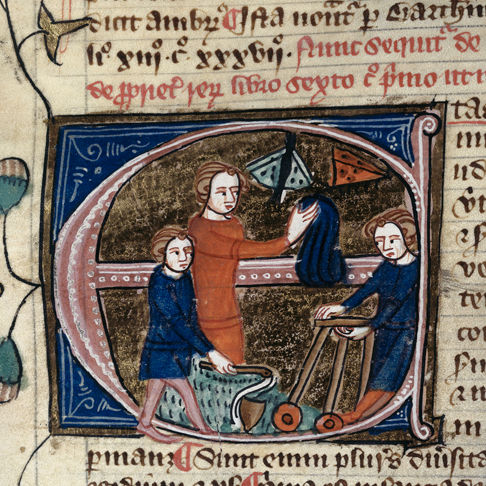
William’s friends in the forest offer a wonderful insight into the simple life of boys in the fourteenth century [ll. 170-197].
Although little is said about his friends, we know William is always generous with them and, when he leaves the forest with the emperor, he makes sure he says goodbye to them all [ll. 359-65].
We leave them behind wishing to know more about Hugonet, Huet the kind-hearted dwarf, Abolet, Martinet (the happy son of Hugo) and Akarin, William’s “kindred friend”. They seem quite beautiful inhabitants of a bucolic world, deep in the greenwood.
The bungling Greek guard
The Greek guard is an amusing cameo [ll.1764-85]. We feel sorry for him as it is he who fails to spot William and Melior eloping from the palace dressed unfeasibly as white bears.
We gain a sense of how medieval people ribbed each other about their own mistakes; in his case, he was so afraid of the “bears” he was trembling in fear unable to act immediately – a subsequent cause of much shame!
The quarrymen

The quarrymen [ll.2242-77] hint at a darker side of life when men, tempted by a rich reward, spot the escaping lovers in a cave in a quarry and make plans to tell the Provost.
The episode exists to show how far the decree by the Roman emperor had reached.
Everyone, the quarrymen included, are aware of the price on William and Melior’s heads.
A fascinating postscript to this episode is when the Werewolf snatches the Provost’s son, causing all the hunters to pursue him and allowing the lovers to escape [ll. 2448-80].
Not only does this give us an insight into the organisation of society but, when the son is left safely by the Werewolf, we are reminded that children – no matter their status – are to be cared for properly.
We are also told how afterwards many of the Provost’s men then rest in inns before going home, adding a tantalising insight into rural society.
The charcoal burners
Still on the run, William and Melior are sleeping when three charcoal burners (described as colliers) stumble across them.
Here we are shown them debating about claiming their reward while one of them says they should be left alone as lovers [ll.2520-55].
The episode shows highlights how the desire for reward can corrupt the soul. Instead, the lead charcoal burner intervenes, saying “How would it be better to do them any distress? … May God, in His great might, save them from grief, and bring them both bliss wheresoever they be!”
The sailors
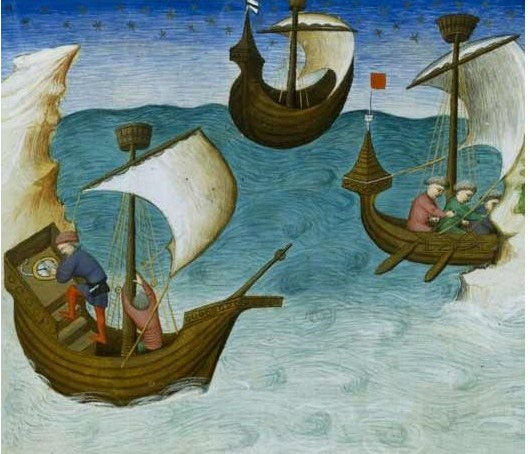
When the Werewolf tries to help William and Melior cross the Straits of Messina, he must hide them on board a ship.
One throwaway line shows how the ships’ master mariners have gone into town to enjoy themselves prior to sailing, opening a completely unseen world which nonetheless exists beyond the framework of the narrative.
But when the ship reaches Sicily the next day, we encounter the violence of simple sailors as they attack the werewolf. Later a boy on the ship (absent in the French source) attacks Melior herself.
The sailors seem the least attractive of the working characters revealed by the story [ll. 2717-2829]. Yet Melior discourages William from taking revenge; a key message of this romance is one of fairness and forgiveness.
Why the common people?
William of Palerne (The Romance of William and the Werewolf) has been noted for its much gentler narrative than its more brutal French source.
The English text also features extensive pleas to God on behalf of the characters – whether between one character and another or from the Narrator on their behalf.
It is argued that the Middle English text is fundamentally linked to its patron Humphrey de Bohun [ll. 162-69; 5530-38], a devout lord and Augustinian who was a life long invalid.
The poem was translated in the shadow of the Black Death. Humphrey was no doubt well aware of the fragility of life and the importance of fairness to everyone, whatever their status.
Humphrey does not emerge like the Greek millionaire’s daughter in the Blur song, holding a patronising attitude to those less fortunate than herself and possessing an easy escape back to her own world.
Instead, through William of Palerne, we see Humphrey de Bohun as devout and compassionate towards others despite his great wealth.
Certain modern politicians, particularly those who stoke hatred and division whilst enriching themselves, could learn a lot from him.
See the book - and buy a copy!
Order a signed, dedicated copy of The Romance of William and the Werewolf

My translation of William of Palerne (The Romance of William and the Werewolf) was published in 2024 in UK (2025 in the US).
As well as a complete translation of the romance, the book also includes: an historical introduction; detailed appendices examining the role of the narrator and the romance's original 12th Century Old French source; comprehensive notes; and a thorough bibliography should you wish to undertake further research into this magnificent romance.
About the author, Michael Smith

I am a British translator and illustrator of medieval literature. I am also an established printmaker, with work in private collections worldwide.
My books, including translations of Sir Gawain and the Green Knight, the Alliterative Morte Arthure, and William of Palerne, are published by Wilton Square Books and are available through all the usual outlets. All my books feature my own linocut prints as their illustrations.
To find out more about me, please click here
For more details of my books and how to purchase signed copies, click here.


Comments