
Sir John Swinford of Spratton, and other wonders of St Andrew's church

The church of St Andrew at Spratton, Northamptonshire is one of those special places. Built from rich golden local stone, the church dates back at least to the twelfth century and was added to as late as the fifteenth century. One of its finest features is the alabaster effigy to Sir John Swinford, who died in 1370/71, still protected in part by its original iron railings.
Norman St Andrew's
St Andrew's as it survives today is a fascinating building, showing both Romanesque and Gothic features and presenting them in a remarkable way.
The nave, dating to ca. 1120, is the oldest part of the building and may well have been built on an earlier Anglo-Saxon church.
The church was then enlarged by the addition of the north aisle and tower in the 1180s; both these enlargements reveal evidence of the Romanesque style.
The church tower at Spratton - an architectural statement piece?

The church tower is of particular note. At its base it is pierced by a doorway on the western side which features an attractive Norman arch of irregular chevrons, executed in a paler stone to the arch immediately below it. Relieving these is a thin layer of stone blocks executed in fine knotwork which, from a distance, resemble the rusticated stonework of much later centuries.
Above the door at first floor level is a blind arcade of three Romanesque arches redolent of St Peter's church at Northampton but also of the rich decoration of Norman castles such as those at Norwich or Castle Rising.
Next are two further levels of decoration. Firstly, a blind arcade of five arches in the Gothic style decorates the tower on all four sides. Then, in most curious fashion, the third floor features bell louvres, again on all four sides, contained within Romanesque arches which themselves are each flanked by two blind arcades in the Gothic style.
Finally, the tower is topped by an extravagant fourteenth century recessed spire, a spire so heavy that the tower itself had to be bound by two iron straps which can still be seen today.
It is possible that the local stone, Northampton Sand, may have encouraged architects into levels of experimentation not normally seen on churches of this side.
Below the battlemented parapet is a corbel table of creatures' faces and grotesques. Although not quite at the same level as the decorative work at Kilpeck in Herefordshire or Barfrestone in Kent, it is possible that the tower at Spratton served, like those churches, as a place where sculptors could practise their skills for work elsewhere.
Norman interior
Much of the original nave of the Norman church has now disappeared beneath the accretion of the centuries and the opening out of the church by the addition of two aisles to the north and south.
Yet it is the northern aisle which still maintains a sense of the original appearance by its arcade of three Norman arches through which the aisle is reached.
In typical Norman fashion, none of the capitals on the supporting pillars for these arches is the same. Notwithstanding, the original stonemasons exhibit a remarkable fluidity of expression, no doubt helped by the softness of the stone with which they work working.
The capital nearest the chancel is the only one of the four to be decorated with creatures' heads at each corner.

The northern aisle itself gives every impression of being rebuilt or altered dramatically in later years; all the windows on this side of the church are clearly later than the twelfth century.
Notably, the southern aisle is approached through an arcade of Gothic arches atop uniform capitals on Norman pillars which suggests another rebuild here.
While the windows to the aisle are later still, the southern doorway features a Norman arch on the outside. This may have been moved there when the aisle was extended outwards or, alternatively, represents its original position as the rest of the aisle was rebuilt around it.
The nave
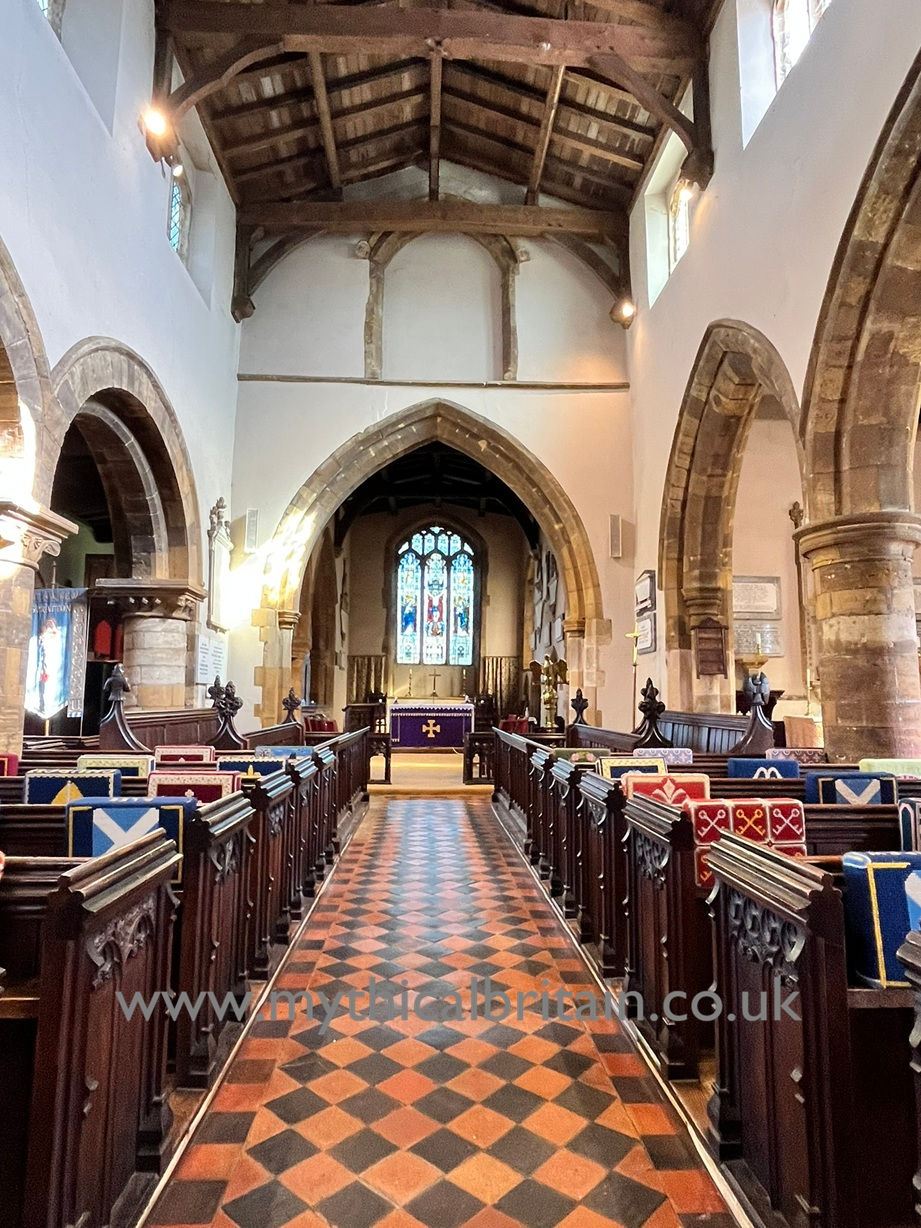
Considerable rebuilding and/or restoration was carried at Spratton in the nineteenth century when new pews, flooring and roof beams were replaced.
Notwithstanding, the finished result has a depth of character suggesting that the architects dealt sympathetically with what they found.
The poppy-headed benches towards the chancel in addition to the finely wrought roof beams all serve to evoke a medieval interior and in a way much less oppressive than so many churches either rebuilt or restored in the high gothic style during this period.
Of particular note, however, is the niche above the chancel arch. This may once have been pierced by a window or, as is suggested in the church guide book, may have been the niche for the Rood, accompanied by figures of Mary and St John.
The nave is also lit by a clerestory, a series of windows towards the roof line, which bring a remarkable sense of light and space to a building which, as originally built, would most likely have been somewhat oppressive with small arched windows only in the nave itself.
Sir John Swinford
As well as the church's fine Norman features, St. Andrew's also provides us with a splendid alabaster effigy of Sir John Swinford (d. 1371), surely one of the most impressive works of its type in England.
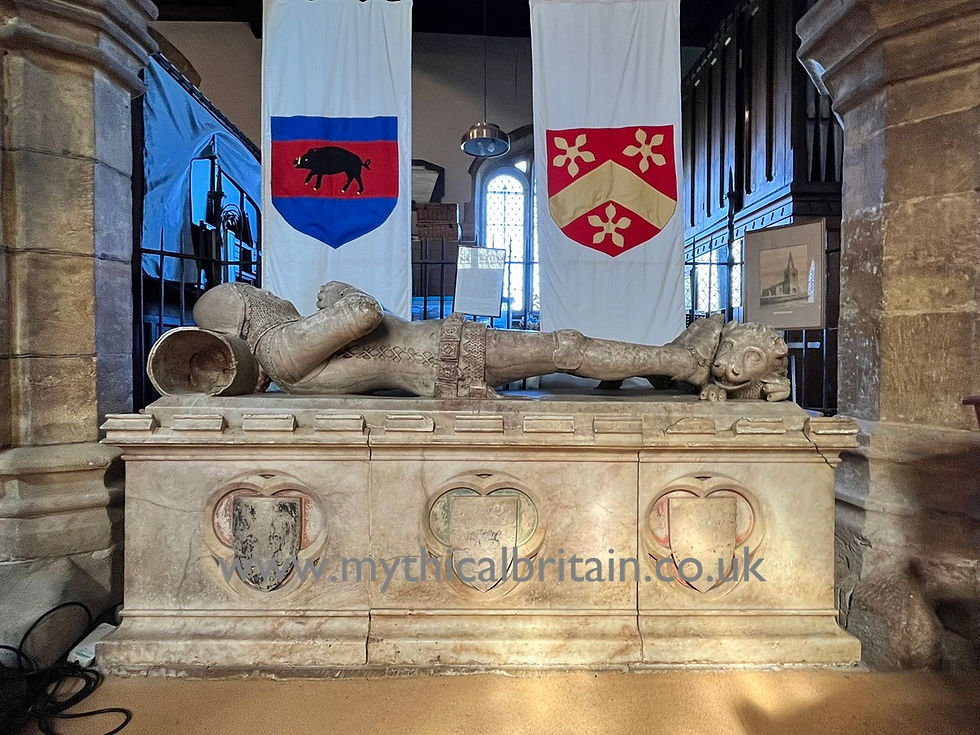
Sir John Swinford became Lord of the Manor at Spratton when he married Joan, heiress to Sir Thomas Arden of Spratton in 1358. He is known to have served in France under John of Gaunt, Duke of Lancaster and brother of the Black Prince.
Both Sir Thomas and Sir John died in 1370 (some sources place John's death in 1371); John's only child, his daughter Elizabeth (aged 12 at his death), went on to marry twice more, first to William de Addebury and then to Roger Chambers (or Chambre). Their great-grandson John Chambers went on to build the chantry chapel at Spratton between 1494 and 1505.
The effigy in the church may have been ordered by either Joan, Sir John's widow, or Elizabeth at a later date. It is curious that Joan herself does not feature given her place in Sir John's title at Spratton.
The Victoria County History tells us that Joan predeceased John in 1366 so it may be that the effigy was ordered by Elizabeth in her father's name only.
Details of the effigy of Sir John Swinford at Spratton
Perhaps the most remarkable feature of Sir John's effigy is its acute sense of detail and accuracy, a feature enabled by the execution of the work in alabaster rather than more friable limestone.
Beginning at his head, we notice he rests upon a decorative processional or jousting helm, topped by a crest featuring the head of a wild boar. Sir John's family crest features a boar on a red fess upon a field of white.
John himself wears an open-faced bascinet, to which is attached a chainmail aventail (or camail). Of particular note is the way the staples attaching this to the helmet are protected by a series of scalloped metal plates. At some point, a knife or sword has been taken to the face but fortunately the damage is slight.

Around his neck, John wears a distinctive collar featuring the letter S in succession which is thought to be the earliest known example on a church effigy.
The collar suggests adherence to the House of Lancaster; it is of note that John of Gaunt's third wife was Katherine Swynford, who herself was married first to John's half-brother Hugh.
As we progress further, we can see that John's arms are dressed wholly in plate but his supplicant armoured hands are covered by what appear to be open-fingered cloth mittens.
Although we can clearly see that he wears articulated finger armour, he does not appear to be wearing full metal gauntlets; perhaps the mittens have a religious function or relate to his role in life? Similar mittens can be seen on the effigies of Sir William Gasgoigne at Harewood, North Riding (ca. 1419), Sir John Savage at Macclesfield (ca. 1470) and Sir Ralph Fitzherbert at Norbury, Derbyshire (ca. 1483) amongst others.
While we look at his hands, a further feature is clear; unlike many other effigies of knights, his hands are not close together in prayer but separate. It is possible that his hands may have once supported an object not part of the sculpture; a book of psalms perhaps, to be sung in Sir John's memory or perhaps something of heraldic, professional or ritual significance, thereby justifying the mittens?
The sense of detail continues to the jupon and decorative belt. The craftsman shows how the cloth of the jupon was held to the armour below by means of laces. Sir John's slender waist is also highlighted; we know from Sir Gawain and the Green Knight [l. 144] that this was a sign of elegance in late fourteenth century.
Sir John's belt also reveals repeat motifs of "J" (shown as "I") and "S", indicative of his name. The belt shows traces of colour which suggest that the whole monument may once have been painted, in the manner of those at Stanton Harcourt in Oxfordshire.
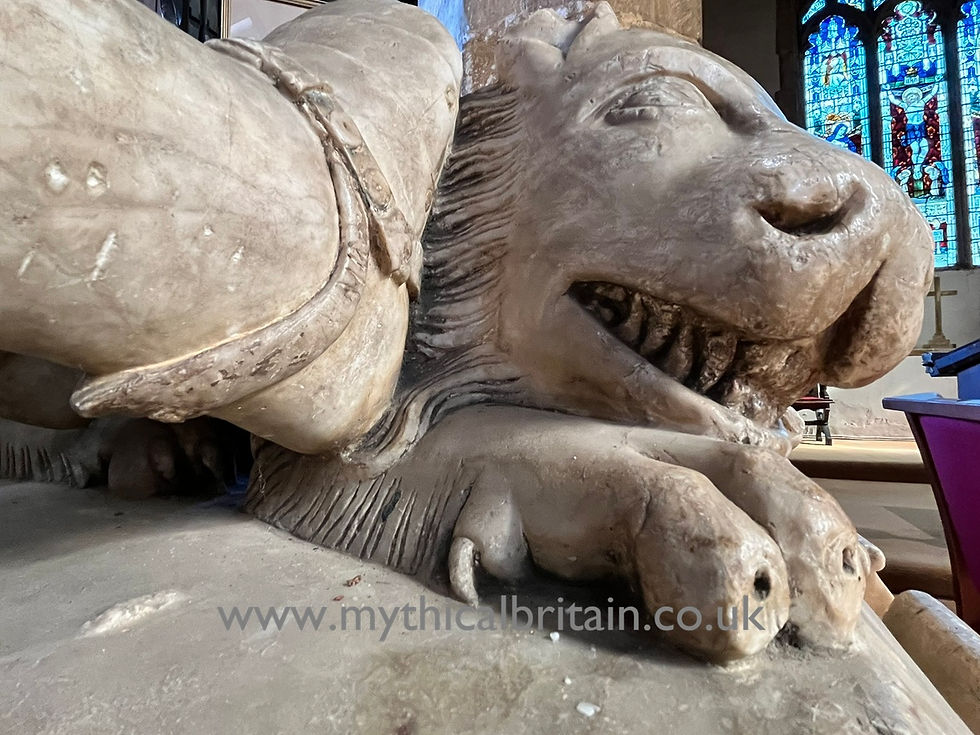
Finally, as we move down to his feet, we notice John wears a richly-decorated sword with a great pommel, and a dagger (now sadly lost except for part of its belt).
As if to emphasise the skill of the craftsman, the tail of the lion at Sir John's feet is wrapped around the scabbard of his sword. The lion itself is of a wondrous beauty, smiling below a lustrous mane; although most of his claws are missing, it can be seen how they were attached by the craftsman as a finishing touch.
It is worth noting that the effigy of Sir John is probably not contemporary with his death and may have been produced some years after his death. The church guidebook mentions research suggesting it was commissioned by Roger Chambers, Joan's final husband. Certainly, the use of alabaster - particularly in such a spectacular way - seems remarkably early; elements of the armour suggest a date possibly shortly after 1400.
In the dangerous years after Bolingbroke's seizure of the crown, an assertion of John's support of John of Gaunt (the new king's father) may well have been a valuable asset in a land which, as the contemporary poem Mum and the Sothsegger reveals, was one of deep suspicion and whispered voices following the death of Richard II.
The iron railings partially surrounding the effigy are a feature rarely seen and in this case only surround part of the monument. The design is redolent to that of Sir Hugh Calveley at Bunbury in Cheshire.
A church of exceptional interest
If you are travelling through England on the old roads, then a stop at Spratton is highly recommended. With its wonderful golden stone, unusual Romanesque and Gothic architectural features, and its magnificent effigy to Sir John Swinford, this is a "must see" church for anyone passing through Northamptonshire.
And for Americans there is something else too! The thirteenth century font is the very font in which Amphillis Twigden was baptised in 1602 - Amphillis was none other than the great-great grandmother of George Washington. What would either think of how things have turned out in a modern America so far from this most special place?
An acknowledgement
I am grateful for the time and consideration shown to me by David Bennett when I visited Spratton earlier this year and who told me so much about a church he clearly loves so much and for which he has done so much to support locally.
It is always a special treat to come across a dedicated Friend or Volunteer parishioner when visiting old churches - you learn so much more than a guidebook can ever tell you! Indeed, there is much more at Spratton than I have described here - you simply must visit!
Gallery showing features and architectural details at St Andrew's Church, Spratton, Northamptonshire
View down the nave towards the chancel. Note the the niche above the chancel arch. The magnificent twelfth century tower at Spratton Effigy and tomb chest to Sir John Swinford (d. ca. 1371) The processional or jousting helm beneath the head of Sir John Swinford's effigy Eternal peace, eternal prayer - the face of Sir John Swinford as imagined by the stonemason A knight at rest, a lion at his feet Fabulous detail - jupon, belt and chainmail I'm a very friendly lion called Parsley... Unusual survival - original iron railings protecting the tomb Noble and Norman - the columns of the North aisle Capital work! Details of one of the Norman columns at Spratton The decorated belt of John Swinford showing the "J" and "S" of his name Flowing forms on another Norman capital Detail of the church tower at Spratton from the east Pointing heavenwards - the fourteenth century spire on top of the tower at Spratton A different angle - St Andrew's seen from the South East Brass rubbings of the Parnells Churchyard cross - a fourteenth century survival North east asymmetry - the late 15th century chantry aisle Faded times, faded lives - the remnants of the Parnells at Spratton
Further information
Historic England listing for St Andrew's, Spratton, click here
For research into early medieval mittens and gloves, click here
About the author, Michael Smith

I am a British translator, illustrator and performer of medieval literature. I am also a printmaker, with work in private collections worldwide.
My books, including a translation of Sir Gawain and the Green Knight and the Alliterative Morte Arthure, are available through all the usual outlets. My translation of The Romance of William and the Werewolf was published in 2024. All my books feature my own linocut prints as their illustrations.
To find out more about me, please click here
For more details of my books and how to purchase signed copies, click here.
Each of my blog posts, my website, illustrations and writing is the result of extensive research. If you would like to support me in my work, please do consider making a donation.


Comments