
The tarnished reputation of King Arthur in Sir Gawain and the Green Knight

The depictions of Camelot, King Arthur and the Round Table are fundamental to the positioning of the narrative and meaning of the alliterative masterpiece Sir Gawain and the Green Knight. But, rather than lauding Round Table as the world-renowned centre of the chivalric ideal, the poem reveals its leader and its code to be fundamentally flawed.
King Arthur and The Matter of Britain
Sir Gawain and the Green Knight is just one of many poems to be written about "The Matter of Britain", one of three "Matters" defined by the medieval French poet Jean Bodel as being of relevance to the 'homme atandant' - the attentive, learned or discerning man. The other two Matters were of France and Rome.
Central to the Matter of Britain is the origin of the island, its history, and the role of King Arthur within that history. In Sir Gawain and the Green Knight, as the narrator-poet makes clear, ever since Brutus arrived to found Britain it was none other than Arthur who was its mightiest king:
“And quen þis Bretayn watz bigged bi þis burn rych
Bolde bredden þerinne, baret þat lofden,
In mony turned tyme tene þat wroʒten.
Mo ferlyes on þis folde han fallen here oft
Ϸen in any oper þat I wot, syn þat ilke tyme.
Bot of all þat here bult of Bretayn kynges
Ay watz Arthur þe hendest, as I haf herde telle...” [ll. 20-26]
(And when Britain was built by this noble man [Brutus], its people were boldly bred, who loved to fight and in many troubled times made mischief. Marvels have befallen more often in this land than in any other I’m aware of since that time. But of all those kings who made Britain great, it was Arthur who was the noblest, as I have heard tell...)
The poet places Arthur as king amongst kings in the history of Britain – not England. He links his ancestry to Brutus and, as we remember from then opening lines of the poem, also to Troy;
"Siþen þe sege and þe assaut watʒ sesed at Troye
And þe borʒ brittened and brent to brondeʒ and askeʒ..." [ll. 1-2]
(Ever since the siege and assault of Troy was over, and that city destroyed and burned to brands and ashes...)

What emerges is that the story we are about to hear takes place in a Britain which came as a result of the end of Troy, Aeneas' travels, the founding of Rome by Romulus [l. 8], of Tuscany by Ticius [l. 11] and of Lombardy by Langobard [l. 12].
The founding of Britain is part of this great sweep of events. The narrative draws from a common story of the founding of Britain, its rescue from Gogmagog and the great giants of the island.
The story is depicted as miraculous and therefore worthy of profound celebration. Brutus was the conduit to better things – “Felix” Brutus, as the poet names him. The Brutus of good fortune.
King Arthur, Sir Gawain and the Matter of Britain
Having placed his subject within the Matter of Britain, the poet zooms in to join Arthur and his court enjoying Christmas festivities.
We are immediately faced with a contradiction. If Arthur is from a long line of kings presumably descended from pagans - Brutus, Aeneas and his “high kind" or "noble race” [l. 5], Romulus etc. - how does he fit within a Christian narrative?
There can be no doubt as to the religious focus of the poem. All four texts within the Gawain/Pearl-manuscript (London, British Library MS Cotton Nero A.x) are the work of a devout writer. Sir Gawain itself ends with a plea to Christ and is laced throughout with Christian narrative and themes.
What seems to be the case is that we are asked to consider Brutus in the manner of Dante's treatment of Virgil, Statius and others in his Divine Comedy. Arthur, it seems, is already a Christian; it seems we are expected to take this for granted and without question.
What matters more to the poet is Britain itself and the story's place within the island's constantly moving history. Arthur stands on the shoulders of pagan giants who, if it wasn't for the inconvenience of being born before Christ, would clearly have been Christians themselves. Arthur, coming later than the country's founders, does not need to be identified as a pagan himself.
So this is a story which celebrates a Christian Britain and yet the story still seems threatened by an undercurrent of paganism, the mysterious Green Knight who emerges from who knows where – and returns there too.
It seems that Arthur’s responsibility is to rule this Britain, this land of constant 'bliss and blunder' [l. 18], and to contain its bubbling, magical undercurrents. But he also has a fundamental responsibility to his subjects and, as the story unfolds, we begin to see Arthur as perhaps the man he is not quite painted to be.
Who is the King Arthur of Sir Gawain and the Green Knight?
King Arthur in Sir Gawain and the Green Knight is depicted as youthful, fun-loving and a man who enjoys a celebration.
Christmas at Camelot seems to be a reflection of the king's vitality. The court enjoys dancing, exchanging gifts and joyously accepting defeat in Christmas games. There are trumpets and drums amid the joy; the atmosphere is magical.

Queen Guinevere sits elegantly below a canopy of rich material from Toulouse and Tharsia; her eyes a bewitching grey. Leading courtiers are also there, including Bishop Baldwin, Sir Agravain of the Hard Hand, Sir Ywain and Sir Urien. We imagine the Round Table at play; all beautiful people.
And yet, whatever our perception of King Arthur from other romances, in Sir Gawain and the Green Knight he seems different.
Although he is shown as a young king, he seems somewhat juvenile, perhaps a tainted king in the manner of a young Richard II.
We read that he is young spirited and boyish (“childgered”, l. 86), his restless mind always seeking stimulation (“brayn wylde”, l. 89). He also refuses to eat until he hears some story of old adventures, a point of honour for him at every feast over which he presides [ll. 91-102].
But if his youth implies playfulness, it also suggests irresponsibility and a lack of long-term thinking.
The weaknesses of King Arthur and the Round Table
When the Green Knight rides into court, his description of the Round Table’s reputation plays to the young king’s vanity when Arthur asks him to stay:
“To wone any quyle in þis won hit watz not myn ernde;
Bot for the los of þe, lede, is lyft vp so hyʒe
And þy burʒ and py burnes best ar holden,
Stifest vnder stel-gere on stedes to ryde,
Ϸe wyʒtest and þe worþyest of þe worldes kynde,
Preue for to play wyth in oþer pure laykez,
And here is kydde cortaysye, as I haf herd carp –
And þat hatz wayned me hider, iwyis, at þis tyme...” [ll. 257-264]
("To dwell any length of time in this hall was not my errand; rather, it is your renown, so loudly extolled, and your castle and your men, who are the most esteemed – the strongest armed men ever to ride horses and the bravest and most worthy of all such in the world, valiant to deal with in any noble sport – and here is courtesy of the best, as I have heard tell, and it is this, most certainly, which brings me here at this time...")
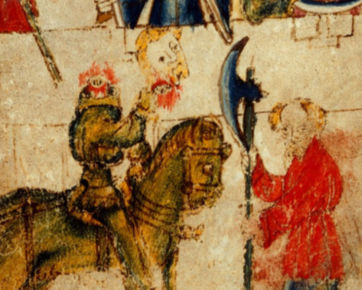
But this speech brings out the worst in Arthur. When the Knight says that he has no armour and bears nothing in his hands save his axe and a holly bough, Arthur believes the visitor is challenging for single combat, or possibly a bare-knuckle fight:
“Arthur con onsware
And sayd, ‘Sir cortuase knyʒt,
If þou craue batayl bare,
Here faylez þou not to fyʒt.’” [ll. 275-278]
(Arthur replied, saying, “Sir courteous knight, if you crave single combat, you’ll not fail to find someone prepared to offer it.”)
Arthur’s is angered; more so when the Green Knight replies, accusing all the Round Table knights of being little but “berdlez chylder” (beardless/adolescent boys) and offering his beheading game. When no-one replies to the challenge, the Green Knight provokes the Round Table further:
“What, is þis Arþures hous […]
Ϸat al þe rouse rennes of þurʒ ryalmes so mony?
Where is now your sourquydrye and your conquests,
Your gryndellayk and your greme and your grete words?
Now is þe reuel and þe renoun of þe Rounde Table
Ouerwalt wyth a worde of on wyʒes speche,
For al dares for drede withoute dynt schewed!” [ll. 309-315]
(“What, is this the house of King Arthur, which is spoken of throughout many realms? Where now is your overweening pride, where now your conquests, your rage and your anger and all your fine words? Now is the revelry and renown of the Round Table all quelled by the words of one man’s speech, for you all cower with dread without one blow being offered!”)
It is at this point in which Arthur cannot control himself and takes the axe himself. It is only when Gawain intervenes, telling the king that for him to take part would be a matter of folly and that his own blood would be a lesser loss, that Arthur hands the axe to his nephew.
Arthur's courtiers condemn their king
Gawain’s decision to accept the challenge sees him behead the Green Knight, only for his adversary to pick up his head, saying he made a promise to the whole hall which he must now keep,
“To þe Grene Chapel þou chose, I charge þe, to fotte
Such a dunt as þou hatz dalt – disserued þou habbez –
To be ʒederely ʒolden on Nw ʒeres morn…” [ll. 450-452]
(“I instruct you, as you have freely chosen, to seek out the Green Chapel and fetch such a blow as you have dealt me; you have well deserved this to be promptly delivered on New Year’s morning.”)
When the Green Knight rides off, the rest of the court returns to its Christmas games and the axe is hung up above the dais. But, as the year goes by and Gawain prepares to ride off to face his nemesis, the view of Arthur’s court has changed towards their king:

“Al þat seʒ þat seemly syked at hert
And sayde soþly al same segges til oþer,
Carande for þat comly, ‘Bi Kryst, hit is scaþe
Ϸat þou, leude, schal be lost, þat art of lyfe noble!
To fynde hyse fere vpon folde, in fayth, is not eþe.
Warloker to have wroʒt had more wyt bene
And haf dyʒt ʒonder dere a duk to haue worþed.
A lowande leder of ledez in londe hym wel semez,
And so had better haf ben þen britned to noʒt,
Hadet wyth an aluish mon, for angardez pryde.
Who knew euer any kyng such counsel to take
As knyʒtez in cauelaciounz on Crystmasse gomnez?’” [ll. 673-683]
(All who looked upon that seemly one sighed in their hearts and each said, one to another, and concerned for him: “By Christ, it is some punishment that you, lord [i.e. Gawain], shall be lost who is of such nobility! To find where the Green Knight lives, in truth, is not simple. It would have been wiser to have acted with more caution and made that man a duke. It would be more befitting for him to be a great leader of men in this world than to have him utterly destroyed and beheaded by some elf-like man on account of arrogant pride. Who ever knew a king to take such counsel as from squabbling knights playing Christmas games?”)
The criticism from the courtiers is damning as Gawain leaves Camelot in search of the Green Knight. Not only do they lament the seemingly inevitable loss of such a young member of the Table but also they accuse their own king of arrogant pride and a man who takes counsel not sensibly but from drunken men at Christmas time.
The Reputation of King Arthur in Sir Gawain and the Green Knight
The overwhelming sense from reading Sir Gawain and the Green Knight is that the court of King Arthur is flawed, arrogant and flippant. The word “sourquederie” (surquedry or overweening pride) is subtly positioned in the text to highlight the flaws not just of Arthur’s court but of all royal courts.

In foregrounding the story by placing Arthur’s reign as the most noble in the history of the kings of Britain, the poet also reminds us that such positions come with responsibility and that reputations can easily be shattered by acts of pride and stupidity.
In showing Arthur as impetuous and not able to learn lessons, the poet is also reflecting on the responsibility of all monarchs to be reflective and to rule wisely, justly and well. In contrast to Gawain's introspection and shame on returning to court after his meeting at the Green Chapel, Arthur is shown as fun-loving, shallow and still not able to grow beyond his youth.
Such failings are a common theme in the work of the alliterative poets; much of what they wrote was a commentary of their own times. And the reputation of King Arthur in Sir Gawain and the Green Knight is fundamentally linked to contemporary times and to audience opinion.
Might Arthur be Richard II, a young king in need of guidance? Might he be Henry Bolingbroke, desperate for legitimacy? Or, if the poem dates from an earlier time, might it suggest the duties of a future Black Prince prior to his early death? The power of the narrative is such that he could be any of these.
Certainly, what emerges from the poem is a critique of the chivalric ideal which became so popular during the reign of Edward III. When Gawain returns to court, having been shamed by his nemesis, Arthur is not shown as humble or regretful.
On the contrary, when Gawain shows the green girdle as a token of his shame, Arthur and his knights' jovial response is redolent of the apocryphal foundation of the Order of the Garter in the 1340s whereby the Countess of Salisbury is said to have lost her garter whilst dancing and Edward III spared her blushes.
Instead of reflection, Arthur celebrates the shame of the Green Girdle as an “adventure” and says that every member of the Round Table should share in the story by wearing a green sash in honour of the adventure itself, not what the adventure revealed.

And yet the poet cannot quite convince himself to end on a note of criticism. Instead, he writes of Arthur’s decision,
“For pat watz accorded pe renoun of pe Rounde Table,
And he honoured pat hit hade, euermore after,
As hit is breued in pe best boke of romaunce.
Pus in Arthurus day pi saunter bitidde,
Pe Brutus bokez peref beres wyttenesse.” [ll. 2519 – 2523]
(For the renown of the Round Table was associated with [wearing the sash] and whoever wore it afterwards was similarly honoured, as it is written in the best books of romance. Thus, this adventure occurred in King Arthur’s day, of which the chronicles of Brutus all bear witness.)
The poet draws us back at the end to how the poem began, placing the action right back in the history - the Matter - of Britain. It seems celebratory, not critical, of the story's characters and their deeds.
Like his treatment of Arthur, it seems, the poet did not feel able to let his audience sense that they had learned a lesson in behaviour - even though they knew they had.
Notwithstanding, sometime after the text was written, a different hand added a final flourish to the poem, adding a slightly corrupted motto of the Order of the Garter:
Hony Soyt Qui Mal Pence – shame be to he that thinks evil of it.
We will never know who wrote this line or why; like all medieval romance, ambiguity lies at its core. What we read and what we learn seem like two totally different things. But that is the power of the poet.
Order your copy of Sir Gawain and the Green Knight

My translation of Sir Gawain and the Green Knight was published in 2018. My publisher is Wilton Square Books.
As well as a complete translation of the romance, the book also includes: an historical introduction; details on the translation and its illustration; comprehensive notes; and a detailed bibliography should you wish to undertake further research into this magnificent romance.
Please help support independent publishers by ordering through me, my publisher or through the independent book trade using one of the channels below. With Bookshop.org you can nominate your local bookseller to receive a percentage of the sales price - helping them survive in a world dominated by online retailers.
About the author, Michael Smith

I am a British translator and illustrator of medieval literature. I am also an established printmaker, with work in private collections worldwide.
My books, including translations of Sir Gawain and the Green Knight, the Alliterative Morte Arthure, and William of Palerne, are published by Wilton Square Books and are available through all the usual outlets. All my books feature my own linocut prints as their illustrations.
To find out more about me, please click here
For more details of my books and how to purchase signed copies, click here.


Comments