
The Birsay Symbol Stone, Orkney

Orkney is world famous for its eclectic range of archaeological wonders, all of which reflect the location of archipelago and its use by marine travellers for centuries. Here, on the Brough of Birsay, we see two such examples: an extensive Viking settlement and monuments from the Pictish era, including the famous Birsay Symbol Stone.
The Picts and the Brough of Birsay
The Brough of Birsay is a small island separated from mainland Orkney at high tide but accessible at low tide via a concrete causeway some 200 yards long.
It is thought that the Picts first came to the Brough in the sixth century and eventually assimilated with later inhabitants, most notably the Vikings, whose large settlement still dominates the island.
Despite this, excavations on the island have revealed substantial evidence of a Pictish settlement here. As well as architectural remains and archaeological finds such as brooch moulds, glass fragments and domestic items, perhaps the most haunting evidence of the Picts is the Birsay Symbol Stone itself, a carved slab featuring several incised images.
The Birsay Symbol Stone and its three warriors
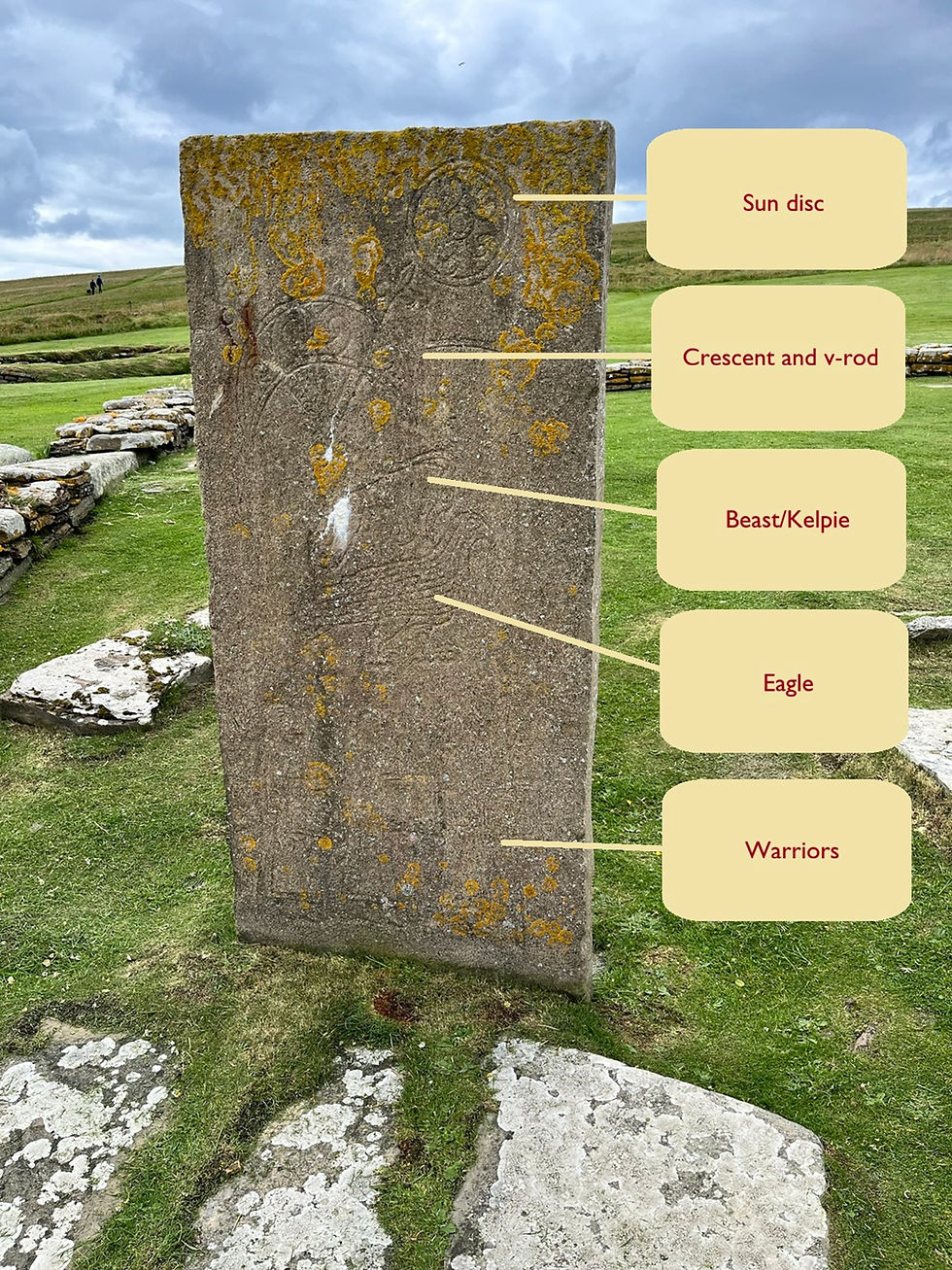
The original stone, now in the National Museum of Scotland in Edinburgh, is sadly much damaged, which means that scholars have had to reconstruct the original appearance of the stone.
Nonetheless, enough remains of the original incisions to reveal that the symbols are typically Pictish, being similar to others found on other stones elsewhere in Scotland. These images include an eagle, a Pictish beast or ‘kelpie’, a crescent and v-rod motif, and a mirror or sun disc.
However, the stone’s most famous feature is its depiction of three robed warriors walking in a line bearing square shields and carrying spears.
Although this quasi-military procession has also been reassembled from the stone's broken fragments, it is nonetheless complete. There are no missing elements, unlike with the images mentioned above.

Wrapped up against the cold winds of the north, the three warriors have a biblical feel to them, resembling Hittite or Persian warriors seemingly washed ashore in some far away land. This is particularly the case with one figure, whose shield is more highly decorated than the others and whose hair may even depict a decorative headdress or possibly a regal crown.
These three mysterious figures were the inspiration behind my own linocut print, of the Birsay Warriors, where I wished to evoke the sense of a haunted land in which the figures and their culture somehow came alive at sunset.

The power and culture of the Picts
Despite the damage to the original stone, it is fitting that a replica of the Birsay Symbol Stone has been made and placed again on Birsay. It contains all the images in full, as the stone would originally have appeared.
This astonishing representation, set in its original environment on the Brough, causes us at once to consider who these people were, how they spoke and what world they knew.
It is known that the Picts occupied large swathes of Scotland above the Clyde and Forth between ca. 300 BCE and 900 BCE. They were governed by local elites, those on the coast often occupying peninsular fortresses, the most famous of which is at Burghead in Moray.

Despite there being no written records of the Picts and their culture, the archaeological picture suggests a sophisticated people; it is known they had international ties.
Their metalwork and jewellery is of astonishing beauty and quality; certainly, the jewellery moulds found at Birsay indicate that this was a place of importance.
But it is their carved stones which both tantalise and confuse at the same time.
These stones, such as the Craw Stane at Rhynie in Aberdeenshire and the later Picto-Scottish Sueno’s Stone near Elgin, suggest a rich and sophisticated culture.
The Birsay Symbol Stone, on its island looking out to sea, tells of a culture which looked beyond itself to others abroad. Here on Birsay, they would have traded with navigators from different lands; perhaps they sold their jewellery and other items.
But quite who the three Birsay figures were, the world they inhabited and the language they spoke, can never be fully known. Today, they watch the seas as if scouring the horizon for those who once knew them and hoping that they will return in ships to tell us of their secrets.
Important notes for visiting the Brough of Birsay
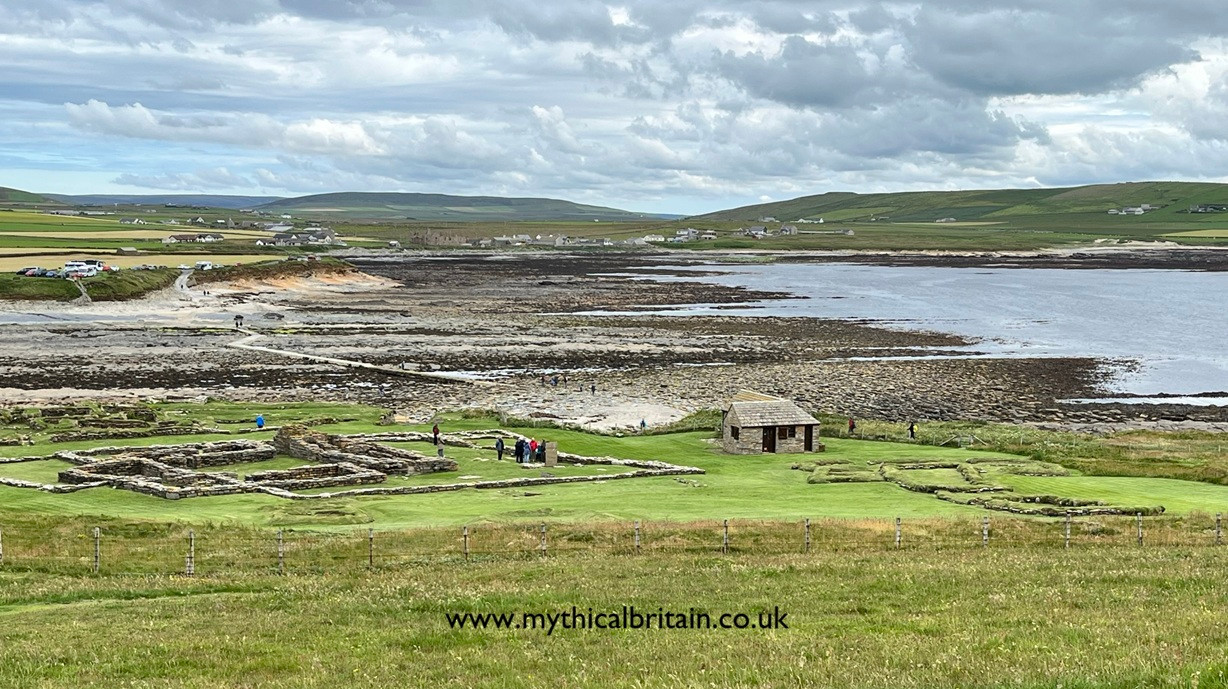
The Brough of Birsay is easy to access by car - except for the last few hundred yards, which must be traversed on foot.
There is a car park just by the causeway where visitors can leave their car before venturing onto the Brough. Please be aware that the causeway is only accessible at low tide; be sure to check the tides before you venture to the Brough - you don't want to limit your time on the island, or worse, get trapped there until the next low tide!
From the island, across the water, it is also possible to see the monument at Marwick Head, which commemorates the loss of HMS Hampshire in WW1. Less than two miles off this head, the warship struck a German mine and floundered, leading to the drowning of some 737 souls, including Lord Kitchener. Only a dozen sailors survived.
Further information about the Birsay Symbol Stone and the Picts
About the author, Michael Smith

I am a British translator and illustrator of medieval literature. I am also an accomplished printmaker, with work in private collections worldwide.
All my books, including a translation of Sir Gawain and the Green Knight and the Alliterative Morte Arthure, are available through all the usual outlets. My translation of The Romance of William and the Werewolf was published in 2024. All my books feature my own linocut prints as their illustrations.
To find out more about me, please click here
For more details of my books and how to purchase signed copies, click here.

Selected images of the Birsay Symbol Stone and the Brough of Birsay
The images below include more detailed photographs of the Brough of Birsay and the Birsay Symbol Stone.
The replica Birsay Symbol Stone on Brisay The Birsay Symbol Stone annotated Leaning in the Landscape - the replica stone today 
The Craw Stane linocut by Michael Smith The view from the Brough towards Orkney Remains of Viking settlement on Birsay More remains of the settlement on Birsay Marwick Head and its monument to Lord Kitchener and those who died on the Hampshire Marwick Head against a dramatic sky 
Evoking the Pictish Warriors - an original linocut by Michael Smith Rough outline drawing showing the location of the three warriors


Comments